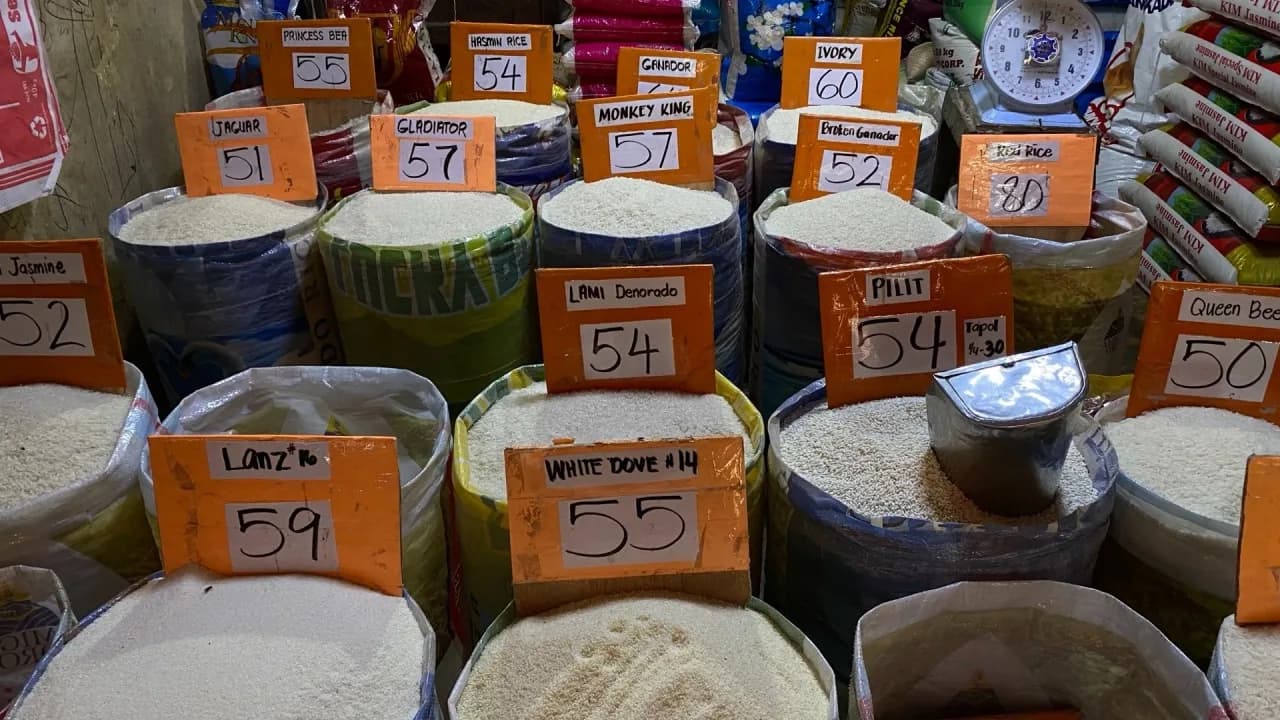
Look at the photograph above. A rice stall in a public market in Cebu, in the Philippines. Ten open sacks, ten cards written by hand: 51, 52, 54, 55, 57, 59, 60. One at 80.
That is how most of the world buys rice. Not from a brochure. From a number on a card.
On 7 August, the chairman of the Cambodia Rice Federation, Chan Sokheang, sat down with Platts, the commodity price service, and said the thing that decides which of those cards Cambodia can ever be written on.
"Our prices are not as competitive as those of our neighboring countries."
Trade bodies do not usually hand that sentence to a price reporter.
What the ladder shows
The same interview carried the arithmetic. That day, Platts put Indian 5 percent white rice, the cheapest in Asia, at $356 a tonne. Pakistan sat $31 above it. Vietnam $78 above. Thailand $88. Myanmar $139.
Line those up and you have the price cards again, lowest first.
Cambodia is not on the card.
None of this is news to anyone who mills here, and the reason is not romantic. It is not that the paddy is worse. It is electricity and it is logistics. Those two lines sit inside every tonne we quote, and they are added long before anyone tastes the rice.
That is not our diagnosis. It is the federation's own. In May this year its president, Lay Chhun Hour, told the same price service that the federation was working with the authorities to bring down production costs, electricity and logistics in particular, in order to compete with Thailand, Vietnam and India. Back in October 2024 the government agreed to cut the power tariff for rice millers and silos, for exactly that reason: to make our exports competitive.
Named in 2024. Still being worked on in May. In August the chairman told a price reporter that our prices are still not competitive.
The problem has been identified, agreed and funded for years, and it is still sitting on the card.
The Philippines test
If you want to know what that admission costs, and what it does not, look at the Philippines.
Cambodia has had access to that market for about three years. For most of them it shipped 2,500 to 3,500 tonnes a year, which in rice terms is a rounding error.
In the first six months of 2026 it shipped roughly 73,000 tonnes.
No price advantage arrived in between. Vietnam is still the main supplier, and Sokheang was blunt about not trying to replace it. What Cambodia offered instead was a second door. Another origin, so that a country eating rice every day is not holding a single supplier. That is a food security argument rather than a sales pitch, and it has worked better than the sales pitch ever did.
Then the part that does not go in a press release. A Cambodian delegation met 35 Philippine importers this year and came home with no commitments on volume. Twenty times the shipments, and nothing agreed for next year. Both of those were true on the same morning, and an exporter has to get up and plan around both.
What is left to sell on
Take price off the table and a Cambodian mill is holding a short list.
Variety is on it. Europe still buys the premium end of what this country grows, and the fragrant crop pays a farmer more than the alternative does. The three grades Cambodia put in front of Philippine buyers this year were premium white, mild fragrant, and premium fragrant.
Consistency is the harder one. A buyer who cannot predict what is in the second container goes back to the cheaper origin, and is right to.
Then there is being able to say where the crop came from, which is a claim about field records and paperwork more than about farming. It is the one most exporters here, ourselves included, still owe work on.
We are in Kampong Thom. We buy from farmers in the province, and we mill and pack what we buy. That structure is what lets us make the last two arguments honestly. It does not finish them.
Paris in October
The federation says Cambodia will show up at around six international trade events before the year is out. That is the practical consequence of one honest sentence. An origin that cannot undercut anybody has to be met in person, tasted, and asked the hard questions face to face.
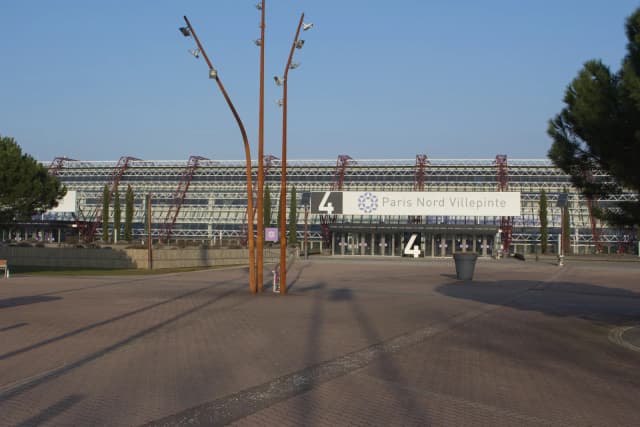
White King Elephant will be at SIAL Paris in October, near the federation's pavilion, with cooked samples and open bags.
The buyers who stop at that stand will not be looking for the cheapest rice in Asia. They already know which card to read.
Cover photograph: a rice stall at Toledo City Public Market, Cebu, by QueenCityCebu, CC BY-SA 4.0, via Wikimedia Commons.