Two Months Late
BRM Team
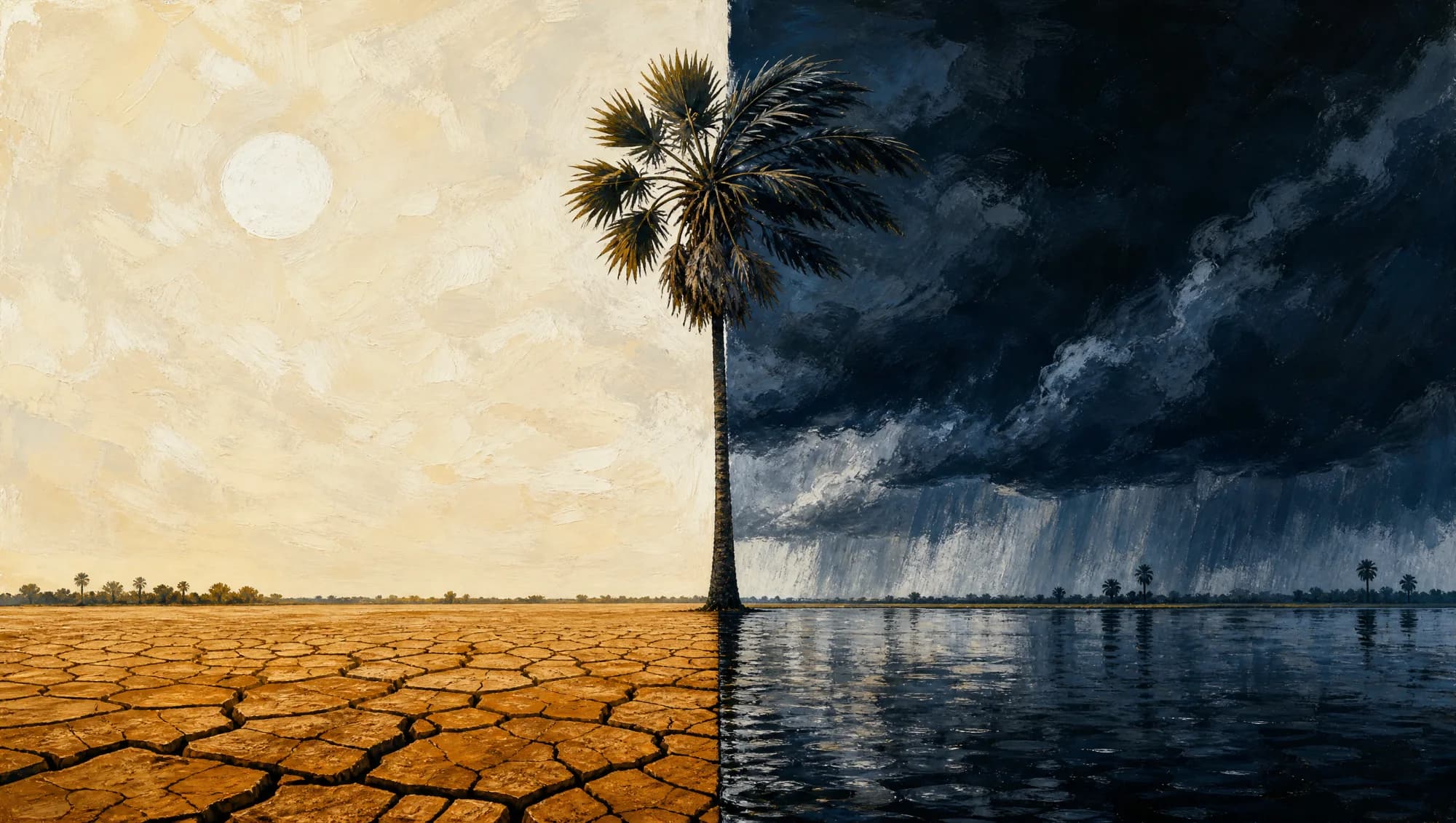
TABLE OF CONTENTS
SHARE
Image: illustration, not a BRM field.
El Niño is Spanish for the boy. Peruvian fishermen named the warm water off their coast after the Christmas child, because it usually arrived in December. This year the boy is early, and he is big.
On 10 September the United States climate agency NOAA gave this El Niño odds it has never given one before: a 75 percent chance that it becomes the strongest since records began in 1950, peaking between October and December.
November to January is when Cambodia brings in its main wet-season harvest, and the short-duration rice that comes in first is normally cut from late July.
This year the first harvest came in late September. The president of the Cambodia Rice Federation says the dry spell delayed it, and pushed the next planting back by almost two months with it.
Part one. What it means for Cambodia
The water
At the end of June the Ministry of Water Resources and Meteorology said rainfall was running about half of last year's. Irrigation reaches roughly two of Cambodia's three million hectares of rice land. The third million is rain-fed.
Through July the drought count grew from 44,453 hectares of rice short of water on 6 July to 289,855 hectares across eight provinces by 30 July, with Battambang carrying the most. The ministry had more than 500 pumps running, and by the end of August the authorities had pumped or carried water to about 147,000 hectares. Half of what dried was saved by diesel.
Then the rain came all at once. By 30 September flooding had damaged 156,125 hectares across ten provinces, about 5 percent of the wet-season crop. Battambang, Banteay Meanchey and Siem Reap were among the worst hit.
Drought in July and floods in September fell on the same provinces.
The Ministry of Agriculture says the floods do not threaten exports or food supply, and it has seed ready for farmers who need to replant. A farmer who replants in October is harvesting in January, in the dry season, from whatever water is left.
The money
Mills report to the federation that they have bought 20 to 25 percent less paddy this season than last. Fewer tonnes against the same fixed costs mean a dearer paddy, and the federation's president has said plainly that a dearer paddy makes Cambodian rice less competitive abroad.
Farmers' costs went the other way. In May, before the drought, farmers in Battambang were paying 5,450 riel a litre for diesel and about 42 dollars for a 50 kilo sack of Vietnamese fertiliser, roughly double a year earlier, at five or six sacks a hectare. Those are the inputs a farmer buys in June and pays for in December. A farmer in Kampong Speu told Cambodianess in September that a one-year drought means close to two years with nothing to eat, because the money for next season's seed goes with this season's crop. Her family had borrowed from a bank for the first time.
The paradox in the export figures
Cambodia shipped 792,212 tonnes of milled rice in the first eight months of 2026, up 67.5 percent on last year, worth 464 million dollars. The federation still expects the country to pass one million tonnes for the first time. All of that rice was harvested before the rains failed in June.
World markets are moving the other way from the Cambodian field. The FAO rice price index rose in September on weather worries and tighter Indica supply. The Philippines has ruled out an import ban this year and could buy up to six million tonnes if El Niño cuts its own crop. Indonesia's retail rice price set a record in September. In May, with the drought still a forecast, the federation's president said that fragrant Phka Malis could reach 870 dollars a tonne from July, and that Philippine demand could strengthen further.
So the Cambodian crop is smaller and dearer at the same moment that its buyers are hungrier. Whether the higher price reaches the farmer who grew it is a separate question. For most farmers in this country the answer is decided by whoever turns up at the gate with a truck. We come back to that below, because in our case it is written into a contract.
One more thing a smaller crop does. From 1 January the European Union's new rice safeguard suspends Cambodia's duty-free access if export volumes surge past a threshold. A short crop makes that trigger less likely. We would rather have had the rice.
The year that is actually at risk
Around the turn of the year the dry-season crop is planted from water held in the reservoirs, and the federation's president has said the major reservoirs are still not full. NOAA's peak runs through December. The last time this happened on this scale, the 2015 drought hit 234,695 hectares of seedlings in 16 provinces, and by May 2016 the prime minister was calling it the worst disaster in a hundred years.
If you want an early Halloween, 2027 is the year to be scared of. It is also the year to plan for.
Part two. What it means for BRM
Where we sit
Our mill and our farmers are in Kampong Thom, in the centre of the country. On the July drought list Kampong Thom had 191 hectares affected while Battambang had 62,554. Part of that is luck. Part of it is water we built. The company owns 2,200 hectares of land here and has cut 17 kilometres of canals and built reservoirs to serve them and the land beside them. Our website says that water permanently secures the mill's supply.
This is the year that sentence gets tested, and we would rather test it in public than in a brochure.
The test has a second half. September's floods reached ten provinces, and a mill's risk in a year like this includes too much water at harvest, paddy coming in wet, and drying capacity. We will know what the rain did to our own fields when the water is off them.
The contract
We buy from farmers under contract, and at signing each farmer chooses a fixed price for the season or the market price at delivery. We supply the seed, fertiliser and crop protection and finance that input stack against the harvest.
Most years the fixed-or-market choice changes little, and this year it will. A farmer who chose the fixed price in a season when paddy is scarce will watch neighbours paid more at the gate. A farmer who chose the market price and lost part of a field will deliver less of a dearer crop, and will be paid this year's price for it. That is the answer to the question in part one: the higher price reaches the farmer who bet on it, in writing, before the rain failed. We will honour both choices, which is the point of signing in advance, and we expect to lose a little margin on some of them.
Input finance matters more in a drought than in a good year. The farmer who has already paid for diesel and fertiliser and then loses the field is the one who borrows from the bank. Our farmers settle at delivery, against the paddy, so a farmer who loses a field does not carry the input bill into the next season.
What we are watching
We are not going to publish our own paddy intake figure, because the season is not finished and a number taken mid-harvest would be wrong by January. We will publish it when the season closes.
We practise alternate wetting and drying on our land, which means we dry fields on purpose, for a week at a time, to save water and cut methane. This year the sky did it for us, for two months, without asking. We will learn from that how far the practice stretches.
And we are watching the reservoirs, because the dry-season crop is pumped from them, and that crop is the 2027 crop.
Paris
We will be at SIAL Paris from 17 October, Hall 8, stand C016. The question we now expect most from buyers is whether there will be enough fragrant rice to ship in 2027, and at what price. We will have this year's rice on the table and this article beside it. The first harvest came two months late, the reservoirs are not full, and the forecasts run dry through December. We will know more in January.
Other Insight You Might Like...
27 September 2026
Hall 8, Stand C016
BRM Agro takes White King Elephant rice to SIAL Paris, Hall 8, stand C016, 17 to 21 October 2026, and the 2027 EU rice safeguard every buyer will ask about.
8 September 2026
The Export Standard Just Arrived in the Domestic Market
Cambodian goods went from 3 percent of the domestic market to about 30 percent, but total industrial output fell. The share moved, the pie shrank, and traceability is what decides who keeps the shelf.
