Driving Past Progress: Inside the Quiet Transformation of Kampong Thom
BRM Team
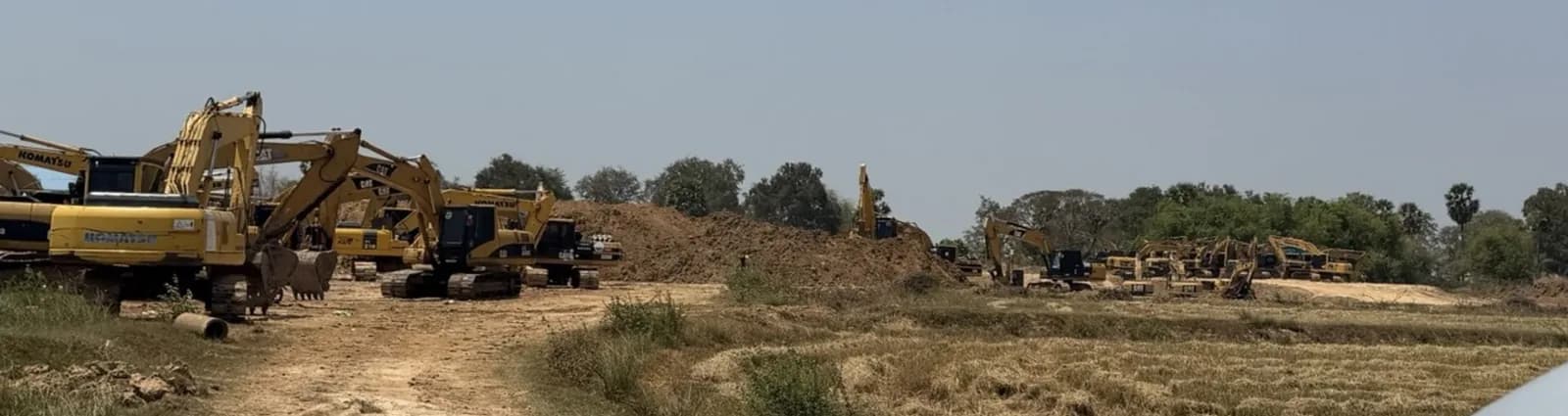
TABLE OF CONTENTS
SHARE
These days, there’s something on every farm visit that we simply can’t ignore.
We make the long drive up from Phnom Penh, pass Wat Tuol Vihear, turn off the main road, and start bumping down the quieter tracks that lead deep into our land in Santuk District. Then, as the rice fields open up, we see them. Excavators. Everywhere. Not two or three. Dozens, probably closer to a hundred. Carving canals into the red earth. Shaping irrigation channels. Building the long, patient veins that will one day carry water across this entire side of the province.
This is the leading edge of the Dang Kambit Reservoir Development Project, and it’s the single most consequential thing happening on our doorstep right now.
Kampong Thom is having a moment. From what we’re hearing on the ground, somewhere in the order of half a billion US dollars is currently being deployed across this one province alone, when you add up the reservoirs, canal networks, roads, and supporting infrastructure under construction. Given how fast things are moving here in 2026, the real figure today is probably higher. Most of it hasn’t been formally announced yet. But you can feel it in the dust on the roads, in the new equipment moving through villages, in the quiet confidence of local officials who know what’s coming.
The flagship piece of all of this, and the one we drive past on every farm visit, is Dang Kambit itself. A US$166 million investment, financed through a concessional loan from China’s Export-Import Bank and built by Guangdong Foreign Construction. As of the March 2026 inspection, it’s roughly 90 percent complete, well ahead of its October 2027 deadline. The concrete dam and turbine works are fully done. The structure runs 2,680 metres end to end, with a concrete section 50 metres wide and 24.5 metres tall, fitted with three large four-by-four-metre sluice gates.
Once operational, Dang Kambit will irrigate 131,323 hectares in the rainy season and 45,360 in the dry, across six districts including ours: Baray, Kampong Svay, Prasat Sambor, Sandan, Santuk, and Stoung. Approximately 25,000 farming families and 85,300 people will benefit. Rice yields in the region are expected to climb from about 4 tonnes per hectare to between 5 and 5.4, a jump of 25 to 35 percent on land that has barely been touched by modern irrigation.
And to put Kampong Thom’s moment into national context: according to figures Prime Minister Hun Manet shared in late 2024, Cambodia has now invested a total of US$1.8 billion in irrigation infrastructure, building 2,300 irrigation systems across 1,100 locations, with combined capacity to irrigate 1.9 million hectares. The Prime Minister himself said plainly that it’s still not enough, and a national master plan is being prepared to push further. That tells you exactly where this country is headed, and Kampong Thom is sitting right in the middle of it.
For BRM Agro, all of this lands very close to home. We farm more than 2,200 hectares in Kampong Thom and source from thousands of contract farmers across the province. Every one of those hectares is about to become more productive, more predictable, and more valuable. Land that has always lived or died by the rainy season is about to have year-round water on tap. The crops we can plan. The second harvest we can confidently commit to. The quality we can promise our buyers. The long-term value of every plot we own. For a vertically integrated rice business like ours, seed to mill to store, water security is the single most important variable in the entire chain. Dang Kambit takes the biggest risk in our model and quietly removes it.
And what’s true for us is true, many times over, for the farmers in our network. A real dry-season crop becomes possible. Land becomes worth more. Income steadier. Decisions bolder. A young farmer here in Santuk can look at the family rice fields and see a future worth staying for, instead of a one-way ticket to the city. That’s the kind of change that ripples through villages for a generation.
Land values are climbing. Outside investors are starting to ask questions they weren’t asking two years ago. The province is quietly moving from “rice basket” to “place to build something serious.” And honestly, not many people outside Cambodia have noticed yet. We have. That’s why we’re here, planted, investing, growing.
To the Royal Government, to MOWRAM, to every operator in those excavators and every engineer behind the plans, thank you. You are building something we will all live inside for decades to come.
If you believe in where Cambodian agriculture is headed, we’d love to connect. Follow BRM Agro for more from the field, and reach out if you’d like to be part of what comes next.
#CambodiaAgriculture #WaterSecurity #SustainableFarming #BRMAgro #KampongThom
Other Insight You Might Like...
8 September 2026
The Export Standard Just Arrived in the Domestic Market
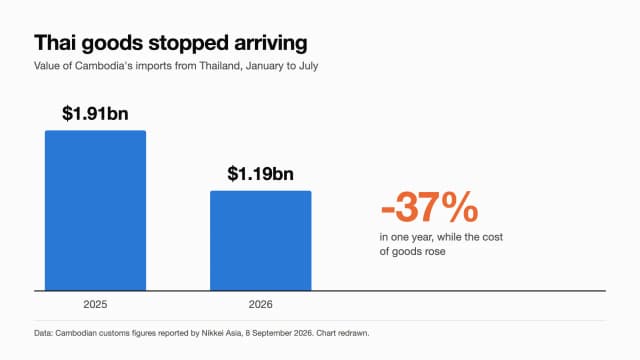
Cambodian goods went from 3 percent of the domestic market to about 30 percent, but total industrial output fell. The share moved, the pie shrank, and traceability is what decides who keeps the shelf.
31 August 2026
The Strategy's First Birthday
Cambodia's milled rice strategy turned one. Exports are up 68 percent, the average price per tonne is down, and premium fragrant rice is where the value held.
