Beyond the Mill: How BRM Agro Is Rebuilding Cambodia’s Rice Value Chain from Kampong Thom
BRM Team
TABLE OF CONTENTS
SHARE
Most rice companies in Southeast Asia follow a simple playbook:
buy paddy from farmers, mill it, bag it, and sell it.
That model works — until you ask harder questions.
Why do Cambodian smallholder farmers still average less than 3 tons per hectare when the crop can yield much more?
Why does premium Cambodian jasmine rice struggle to command consistent prices in Europe and the United States, even though it has won World’s Best Tasting Rice7 out of 12 years at the TRT World Rice Conference?
And why do so many rural families remain trapped in low-income farming, season after season?
The answer isn’t a better version of the status quo.
It’s a different system altogether.
BRM Agro, based in Kampong Thom province, is building that system from the ground up — literally.
We own and operate over 2,200 hectares of freehold rice farmland, and we control every step from seed development to export. This isn’t just farming at scale. It’s vertical integration, designed to solve the disconnect that keeps Cambodian rice undervalued and farmers underpaid.
Here’s what that looks like in practice — and why it matters.
Cambodia’s Rice Potential: An Unrealized Opportunity
Cambodia is one of the world’s major rice producers, and Kampong Thom sits at the heart of the country’s rice belt.
The soil is rich.
The Tonle Sap system provides nutrient-rich water.
Cambodian jasmine varieties are prized for fragrance and texture.
As mentioned, Cambodia’s Angkor Malys variety consistently wins the World’s Best Tasting Rice Award.
But potential isn’t the same as performance.
Most Cambodian rice farms are small, fragmented, and reliant on inconsistent seed, minimal inputs, and unpredictable weather. Yields hover around 2.8 tons per hectare nationally.
Farmers sell wet paddy to traders at take-it-or-leave-it prices.
Quality is variable.
Traceability is nearly impossible.
And the premium international buyers are willing to pay for certified, traceable jasmine rice?
It rarely reaches the farmers who grow it.
BRM Agro was founded to change that equation — not by working around farmers, but by working with them, and by investing in the infrastructure and systems that make premium rice production possible at scale.
Vertical Integration: From Seed to Export
When we say BRM Agro is vertically integrated, here’s what we mean:
🌾 Seed development and seed bank
We manage our own seed program, selecting and multiplying the best Angkor Malys and other jasmine varieties. Better seed is the first step to better yields.
🚜 Plantation operations across 2,200+ hectares
We farm our own land using modern agronomic practices: precision leveling, controlled irrigation, integrated pest management, and soil health monitoring.
Our average yield exceeds 5 tons per hectare — nearly double the national average.
🏗️ Public infrastructure built by BRM
We’ve constructed approximately 18 km of roads and 17 km of irrigation canals in Kampong Thom.
These are not just for our plantation. They serve neighboring smallholder farms — reducing post-harvest losses, improving dry-season water access, enabling transport to markets, access to medical care, and children’s access to schools.
🏭 Modern milling facility
Our Kampong Thom mill is designed for quality and consistency. We process both our own paddy and contract paddy from partner farmers, maintaining tight controls on moisture, color sorting, and packaging to meet export standards.
The mill is SMETA-certified to meet EU standards and holds EcoCert certification, allowing us to process organic rice when required.
🌍 Direct export channels
BRM supplies premium jasmine rice to buyers in Europe, the United States, and beyond. We manage logistics, certifications, and quality assurance end-to-end — so buyers get traceability and farmers get stability.
This integrated model eliminates the fragmentation that plagues most rice supply chains. It allows us to guarantee quality, plan harvests around buyer demand, and reinvest margin back into the system instead of losing it to intermediaries.
Farmer Livelihoods: The 4–5× Income Opportunity
Vertical integration isn’t just about efficiency.
It’s about leverage — and at BRM, we use that leverage to lift smallholder incomes.
Through contract farming arrangements, we partner with farmers in Kampong Thom to expand production beyond our own plantation. We provide:
- Quality seed from our seed bank
- Agronomic training on jasmine rice best practices
- Inputs and support, including fertilizer and pest-management guidance
- Access to irrigation through BRM-built canals
- Fair, predictable pricing tied to quality and volume
- Guaranteed access to trusted third-party services such as drone spraying, harvesters, and tractors — services many smallholders cannot access cost-effectively on their own
The result?
Farmers in our network see yields rise significantly. With higher yields, better quality, and reliable off-take, household incomes have increased by 4–5× compared to elsewhere in the country.
This isn’t charity. It’s alignment.
When farmers succeed, we succeed. When the rice is better, everyone benefits — the farmer, the mill, the exporter, and the end buyer.
For rural families in Kampong Thom, that income difference is transformative. Children stay in school. Families invest in health and housing. Farming becomes a livelihood worth staying in — not something to escape.
Quality, Certification, and the Premium Market
Premium buyers in Europe and the United States don’t just want good rice. They want assurance.
They want to know the rice is safe, ethically produced, non-GMO, and increasingly, sustainably grown.
BRM Agro meets those expectations.
Our Angkor Malys Jasmine Rice is aromatic, naturally fragrant, and grown to strict quality standards. Our mill holds EcoCert certification for organic processing and has passed SMETA audits, adhering to rigorous food safety and non-GMO protocols aligned with EU and US import requirements.
This level of certification is still rare among Cambodian rice producers — and that’s exactly why it matters.
It opens doors.
It builds trust.
And it allows Cambodian jasmine rice to be positioned not as a commodity, but as a premium product with provenance and accountability.
Partnerships and the Path to Regenerative Agriculture
BRM Agro does not operate in isolation.
We actively collaborate with development programs and partners aligned with a more sustainable, inclusive rice sector. We’ve participated in initiatives linked to USAID and CASA, supporting investments in drying infrastructure, storage, milling upgrades, and regenerative agriculture practices.
Regenerative agriculture — focused on soil health, water conservation, and biodiversity — is not a buzzword for us. It’s a necessity. Cambodia’s rice sector must adapt to climate variability, and BRM is committed to leading that transition while maintaining productivity and profitability.
A Vision Rooted in Kampong Thom
BRM Agro’s ambition is clear: to build a scalable, regenerative, and profitable rice platform that starts in Kampong Thom and demonstrates what’s possible when farming, infrastructure, and markets are aligned.
We’re proving that vertical integration can work in Cambodia.
That smallholder farmers can thrive when treated as partners, not suppliers.
And that Cambodian jasmine rice can compete at the highest levels of the global market — not by lowering standards, but by raising them.
This is more than milling rice.
It’s rebuilding a value chain from the roots up.
👉 Follow BRM Agro on LinkedIn to see how we’re transforming rice in Cambodia — one field, one farmer, one harvest at a time.
Interested in partnership, investment, or a visit to Kampong Thom?
Reach out. We’d be glad to show you what’s growing here.
Other Insight You Might Like...
8 September 2026
The Export Standard Just Arrived in the Domestic Market
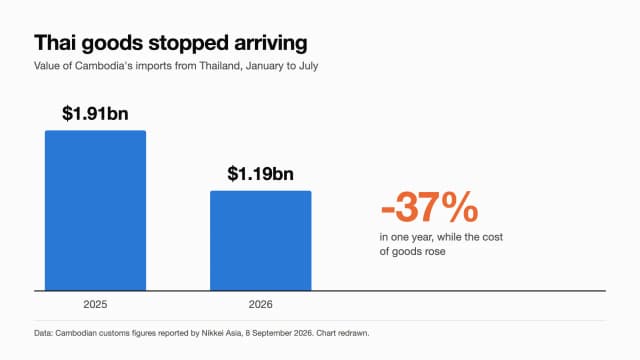
Cambodian goods went from 3 percent of the domestic market to about 30 percent, but total industrial output fell. The share moved, the pie shrank, and traceability is what decides who keeps the shelf.
31 August 2026
The Strategy's First Birthday
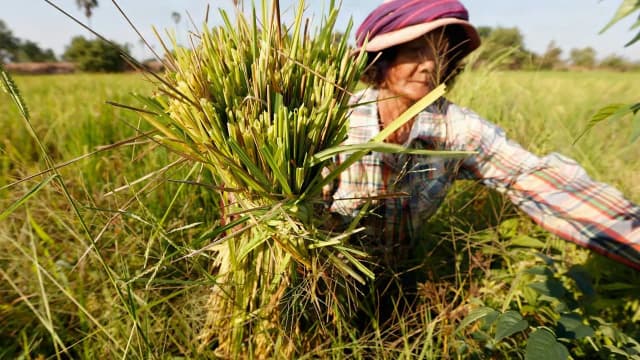
Cambodia's milled rice strategy turned one. Exports are up 68 percent, the average price per tonne is down, and premium fragrant rice is where the value held.
